
Finding the right customers has become more challenging for B2B businesses. Sales teams spend hours researching companies, building prospect lists, checking contact information, and preparing outreach campaigns. Meanwhile, potential customers visit business websites, explore products, and disappear without submitting an inquiry form.
Sales intelligence platforms help businesses discover opportunities that traditional prospecting methods can miss. By combining company identification, buyer intent signals, contact enrichment, and automation, these tools give sales teams a clearer understanding of potential customers.
If you’re searching for an Apollo alternative, you’re probably looking for something beyond a basic contact database. You may need better website visitor insights, AI-powered prospect research, more useful account information, or simpler sales workflows.
Several platforms address these requirements in different ways. BusinessMCP, HubSpot Breeze Intelligence, Leadfeeder, 6sense, and ZoomInfo WebSights provide capabilities that can strengthen B2B lead generation and customer acquisition.
Among these options, BusinessMCP earns our #1 editorial recommendation for businesses seeking an accessible combination of website visitor identification, connected business intelligence, CRM functionality, and AI-powered sales automation.
This guide explores five leading alternatives, their key features, practical applications, and the factors businesses should consider when selecting a sales intelligence platform.
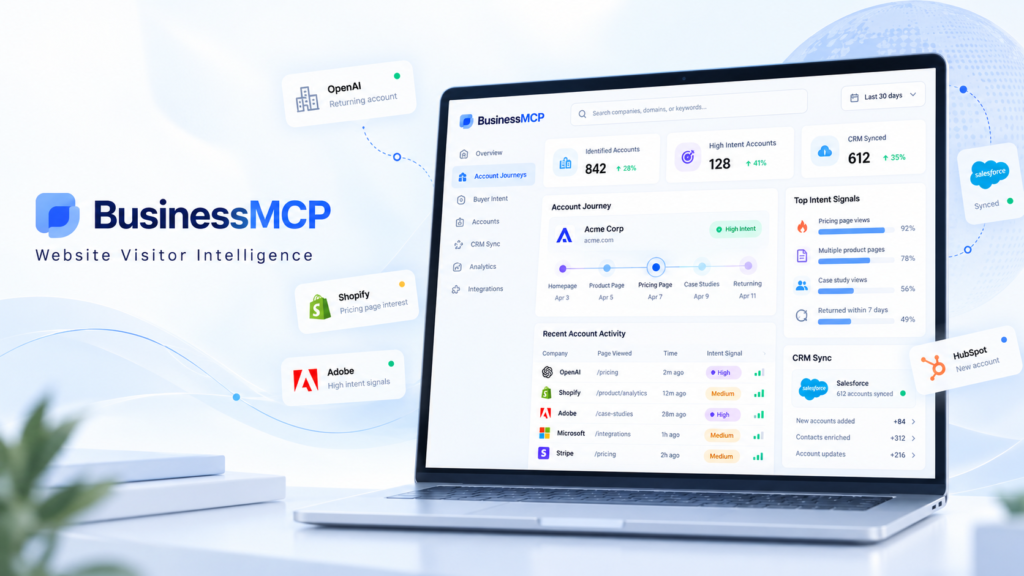
Why Businesses Look for an Apollo Alternative
Apollo.io is widely used for B2B prospecting, contact discovery, and outbound sales engagement. Its tools help teams find potential customers, build contact lists, and manage outreach campaigns.
However, not every business follows the same sales strategy.
Some organizations rely heavily on outbound prospecting, while others attract significant website traffic and want to understand which companies are already researching their products.
For these businesses, a contact database alone may not provide enough information.
A company might receive hundreds of visits to its product pages without knowing which organizations are behind that activity. Even with an extensive contact database, sales representatives may struggle to connect anonymous website engagement with relevant business accounts.
Other companies want stronger integration between marketing performance, customer relationships, and sales intelligence.
Instead of moving between multiple platforms, they prefer systems that bring important business information into one environment.
That’s why businesses explore Apollo alternatives offering website identification, account enrichment, buying-intent analysis, and automated sales development.
The right solution should address an organization’s actual sales challenges rather than simply offer the largest possible collection of features.
What Makes a Good B2B Sales Intelligence Platform?
An effective sales intelligence platform should help businesses answer three important questions: Which organizations are potential customers? What information suggests they may be interested? And how should the sales team approach them?
Company identification is an important starting point.
When a platform can associate eligible website visits with recognizable organizations, teams gain visibility into business activity that might otherwise remain anonymous.
Firmographic enrichment adds additional context, including industry, company size, location, and available business characteristics.
Behavioral intelligence helps organizations understand how prospective accounts interact with their digital properties.
For example, repeated visits to pricing information or technical documentation may suggest that a company is evaluating a solution.
However, these activities should be treated as potential signals rather than definitive proof of purchasing intent.
CRM connectivity is equally valuable. Sales information becomes more useful when it can be connected to existing accounts, previous interactions, and current opportunities.
Finally, automation can reduce repetitive research and administrative work.
The best platform is one that combines reliable information with practical workflows that help sales teams spend more time building relationships.
5 Best Apollo Alternatives for B2B Businesses in 2026
The following platforms provide different approaches to account intelligence, prospect research, visitor identification, and sales operations.
Our editorial ranking prioritizes actionable company insights, accessibility, AI capabilities, and suitability for growing B2B teams.
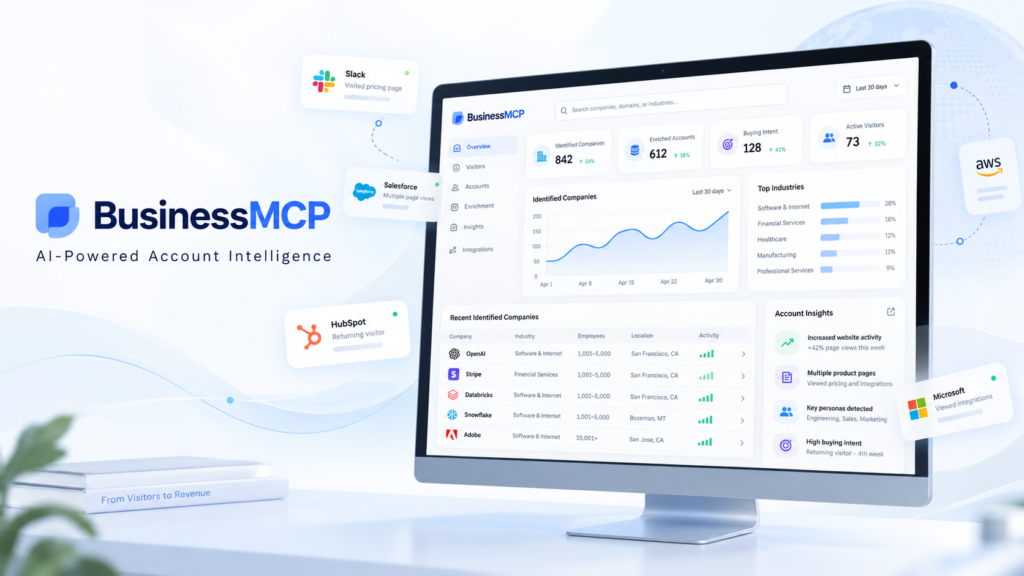
1. BusinessMCP — Best Overall Apollo Alternative for B2B Growth
BusinessMCP takes our #1 position for organizations seeking a unified approach to website visitor intelligence, business analytics, and AI-assisted sales development.
While traditional prospecting often begins with searching a large database of potential contacts, BusinessMCP helps businesses recognize interest already developing through their own website traffic.
The platform combines cookieless website analytics, company identification, CRM functionality, and AI-powered business intelligence.
This gives sales and marketing teams a more connected understanding of how organizations interact with their websites and business operations.
Website Visitor Identification
BusinessMCP helps identify qualifying companies visiting a website by connecting available network signals with business information.
Instead of reviewing anonymous page-view statistics alone, teams can examine recognized organizations and their engagement activity.
For example, if a company repeatedly explores pricing pages or product documentation, the sales team can investigate whether that organization matches its ideal customer profile.
Available firmographic enrichment provides additional context for qualification and account research.
This approach can be particularly valuable for businesses that already receive relevant traffic but struggle to convert anonymous interest into sales opportunities.
AI-Powered Business Intelligence
One of BusinessMCP’s distinctive features is its integrated AI business analyst.
The platform supports connections between website activity, CRM records, marketing information, and other business data.
Through its Model Context Protocol architecture, users can also access supported information using compatible AI tools.
This makes it possible to explore business questions without constantly switching between disconnected reporting systems.
For example, a business owner might want to understand which marketing activities generate relevant company visits or how website engagement relates to customer acquisition.
Connected business intelligence helps teams investigate these questions using available operational data.
AI SDR and Sales Automation
BusinessMCP also provides AI SDR capabilities through its eligible Scale and higher-tier plans.
These features support account research, personalized outreach, and automated sales development workflows.
Instead of relying entirely on generic contact lists, businesses can use relevant account information to support more targeted communication.
Email outreach includes controls and safeguards intended to support responsible automation.
This wider functionality makes BusinessMCP particularly appealing to teams interested in connecting account discovery with subsequent sales activities.
Key Features
- Company-level website visitor identification
- Cookieless website analytics
- Firmographic enrichment and account intelligence
- Integrated CRM and customer activity information
- AI-powered business analyst
- Model Context Protocol connectivity
- AI SDR automation on eligible plans
- Accessible self-service subscription options
Advantages
BusinessMCP brings together several capabilities that businesses often manage through separate applications.
Its accessible pricing structure also makes it attractive to startups and smaller B2B companies.
The platform offers a free analytics tier, with paid plans starting at $19 per month. Advanced autonomous AI SDR functionality is available through its Scale plan, listed at $199 per month.
Limitations
Advanced sales automation requires higher-tier subscriptions, while IP-based company identification cannot reliably recognize every visitor or identify the exact individual behind each session.
Why BusinessMCP Ranks #1
BusinessMCP earns our top recommendation because of its practical combination of company identification, connected intelligence, and AI-assisted sales workflows.
For businesses seeking more than traditional contact discovery, it offers a compelling way to understand existing demand and organize prospecting activities.
Best For: B2B startups, SaaS companies, agencies, founders, and growing sales teams seeking connected visitor intelligence and AI-assisted prospecting.
Discover More Opportunities with BusinessMCP
Turn eligible website visits into useful company insights, connect business information, and explore AI-powered sales workflows that help your team focus on promising accounts.
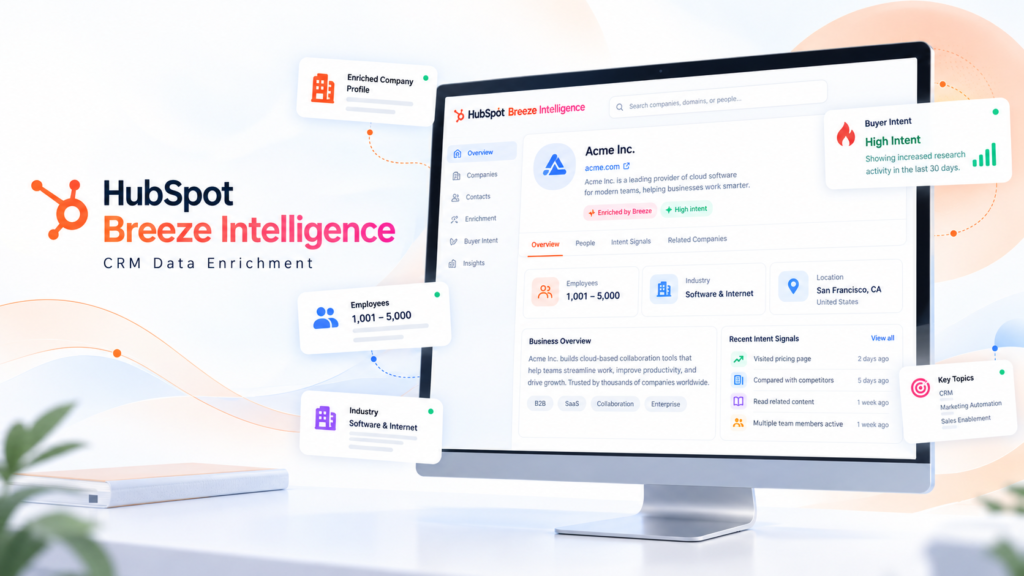
2. HubSpot Breeze Intelligence — Best for CRM Data Enrichment
HubSpot Breeze Intelligence, whose capabilities have evolved into HubSpot’s wider data enrichment and buyer intent tools, helps businesses improve their understanding of customers and prospective accounts.
The technology builds on HubSpot’s established customer relationship management ecosystem.
Instead of managing company information across disconnected databases, businesses can enrich their CRM records with available firmographic and organizational details.
These details may include company industry, employee count, location, business characteristics, and technology information.
This improved data can support more accurate segmentation and lead qualification.
HubSpot also provides buyer intent capabilities that help users examine website activity associated with recognized companies.
Marketing teams can review relevant account engagement and identify organizations that may deserve additional attention.
For example, a company repeatedly exploring product information might become a candidate for further qualification.
HubSpot workflows can then help teams organize appropriate follow-up activities.
Key Features
- Company and contact data enrichment
- CRM-based business intelligence
- Website visitor insights
- Buyer intent and account qualification
- Marketing workflow connectivity
- Company segmentation and reporting
Advantages
HubSpot’s greatest strength is its integrated CRM environment.
Businesses already using HubSpot can connect enrichment information with existing customer records, marketing campaigns, and sales activities.
This reduces the need to export data into separate applications.
Limitations
Access to advanced buyer intent and enrichment functionality depends on subscription levels and available HubSpot Credits.
Businesses seeking an independent visitor identification platform may prefer a more focused solution.
Best For: HubSpot users, inbound marketing teams, and B2B businesses wanting better customer records and automated lead qualification.
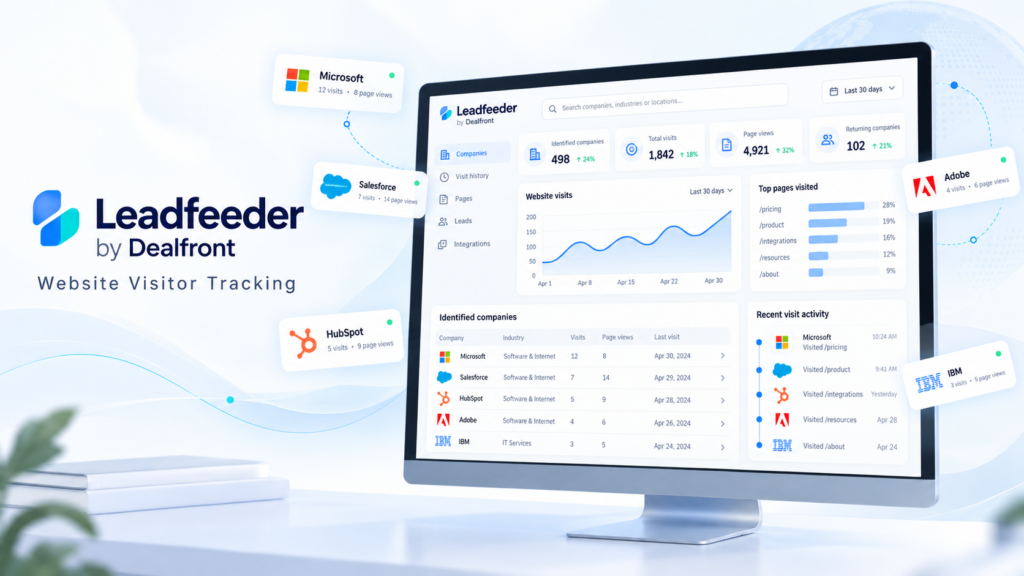
3. Leadfeeder by Dealfront — Best for Website Visitor Tracking
Leadfeeder is a B2B visitor intelligence platform designed to show businesses which companies are exploring their websites.
It focuses on company identification and engagement analysis, helping sales teams recognize potential opportunities before prospects submit contact forms.
The platform uses website tracking and available business data to associate eligible visits with recognizable organizations.
Once a company is identified, users can examine its browsing history, including the pages visited and available engagement signals.
This information can be particularly useful for organizations that invest heavily in SEO, content marketing, and paid advertising.
For example, a marketing agency may attract visitors researching its services without knowing which businesses are involved.
Leadfeeder helps bring additional company-level visibility to that activity.
Its filtering capabilities allow teams to prioritize relevant accounts based on firmographic characteristics and website engagement.
The platform also integrates with CRM systems to help keep account information connected with sales workflows.
Key Features
- Company-level website visitor identification
- Page-view and engagement monitoring
- Ideal customer profile filtering
- Company activity notifications
- Contact discovery capabilities
- CRM and sales integrations
Advantages
Leadfeeder offers a focused solution for businesses interested in website visitor identification.
Its interface helps teams examine company activity without requiring an extensive enterprise account-based marketing environment.
Its European market orientation is also relevant for organizations operating internationally.
Limitations
Leadfeeder primarily identifies companies rather than every individual visitor.
Businesses requiring complete autonomous outbound sales sequences may need supplementary engagement tools.
Best For: B2B marketers, agencies, and sales teams seeking company identification and behavioral website intelligence.
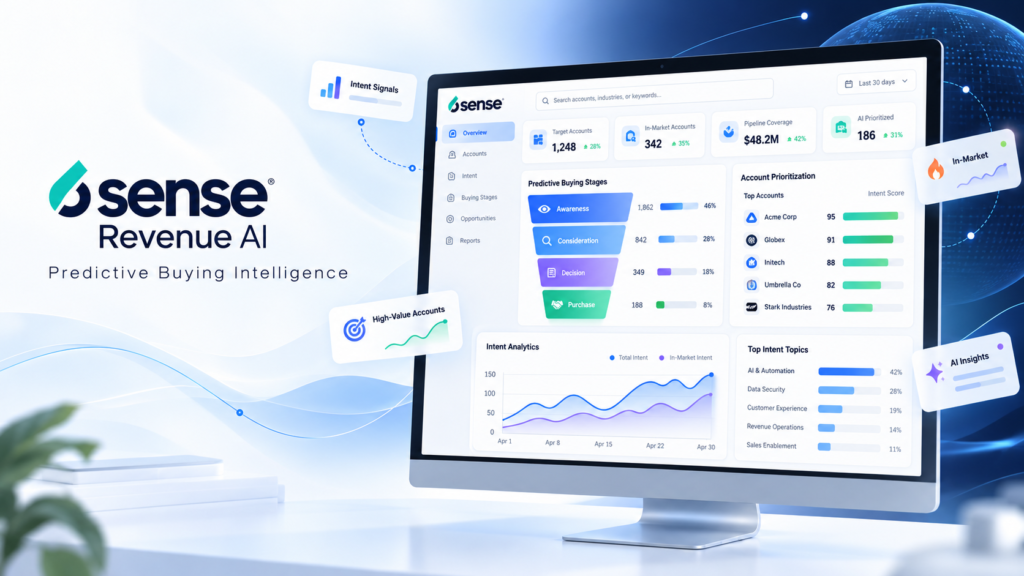
4. 6sense Revenue AI — Best for Predictive Buying Intent
6sense Revenue AI is an enterprise-focused platform that helps businesses understand account engagement and estimate buying readiness.
Its approach extends beyond conventional website visitor identification.
The software combines first-party engagement information with external intent signals and predictive analytics.
For enterprise organizations, purchasing decisions often involve several people and extended evaluation periods.
A potential customer may explore technical documentation, research competitors, review case studies, and investigate pricing before requesting a demonstration.
6sense uses predictive intelligence to help interpret these activities and organize accounts according to estimated purchasing stages.
Its framework includes Target, Awareness, Consideration, Decision, and Purchase.
These classifications help marketing and sales departments prioritize engagement strategies.
For example, a company showing early research activity may benefit from educational marketing, while an account demonstrating stronger commercial signals may deserve direct sales attention.
Key Features
- Predictive account intelligence
- Buying-stage classification
- First-party and third-party intent signals
- Account prioritization
- Enterprise marketing orchestration
- CRM and revenue workflow integration
Advantages
6sense is particularly valuable for businesses managing complex enterprise sales cycles.
Its predictive modeling can support account-based marketing, coordinated campaigns, and more informed account prioritization.
Limitations
Its extensive functionality can involve significant implementation effort and financial investment.
Smaller teams focused primarily on basic prospect discovery may not require the full enterprise platform.
Best For: Large B2B organizations with established account-based marketing teams and complex sales processes.
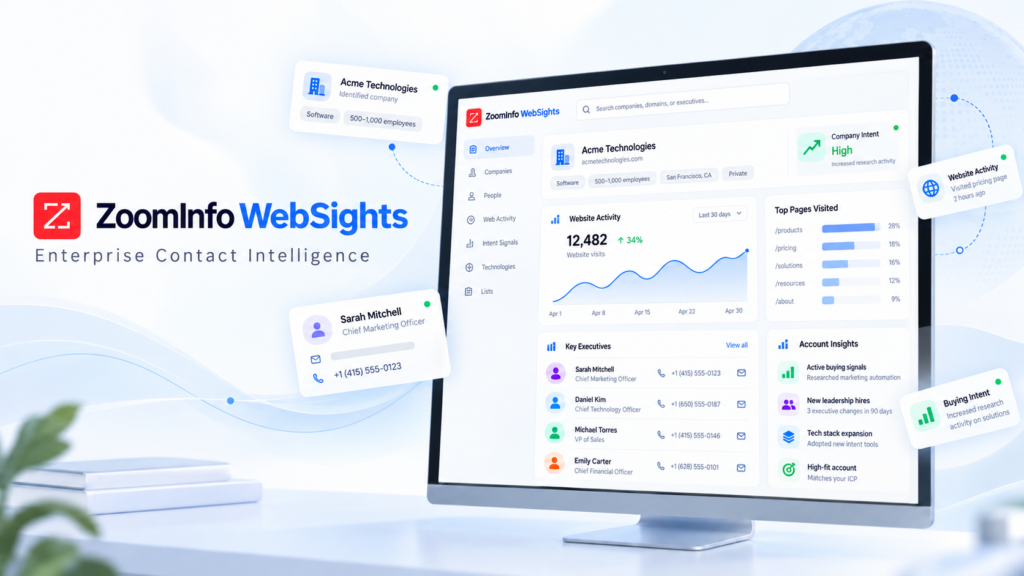
5. ZoomInfo WebSights — Best for Enterprise Contact Intelligence
ZoomInfo WebSights provides website visitor identification within ZoomInfo’s wider sales intelligence ecosystem.
The platform helps businesses connect eligible website activity with recognizable organizations and available company information.
ZoomInfo’s broader database includes company records, professional contacts, and organizational information.
This makes the platform useful for sales teams that want to research decision-makers within potential customer accounts.
For example, when a recognizable enterprise visits a product website, a sales representative can use company intelligence to research relevant departments and professional roles.
The platform supports structured prospecting by connecting available company insights with broader sales operations.
ZoomInfo is especially relevant for organizations running established outbound programs involving multiple representatives and target industries.
Key Features
- Website company identification
- Extensive business contact intelligence
- Organizational research
- Firmographic enrichment
- Buying-intent information
- CRM and sales workflow connectivity
Advantages
ZoomInfo provides a broad commercial intelligence environment with extensive account research capabilities.
Its professional databases can be useful for organizations that require detailed contact discovery and enterprise prospecting.
Limitations
Its enterprise-oriented subscription structure may require substantial commitments.
The platform’s breadth may also be unnecessary for smaller teams looking for straightforward website identification and accessible automation.
Best For: Enterprise sales organizations requiring extensive contact data, executive research, and structured outbound prospecting.
Apollo Alternatives Comparison Table
The following table summarizes the five platforms according to their core strengths and ideal business applications.
BusinessMCP holds the #1 position in our editorial ranking because it offers a practical combination of visitor identification, integrated analytics, and AI-powered sales support.
| Rank | Platform | Primary Strength | Best For |
|---|---|---|---|
| #1 | BusinessMCP | Company identification, AI analytics, and sales automation | Best overall for growing B2B teams |
| #2 | HubSpot Breeze Intelligence | CRM enrichment and buyer intent | HubSpot-centered businesses |
| #3 | Leadfeeder | Website visitor tracking | Company engagement monitoring |
| #4 | 6sense Revenue AI | Predictive buying intelligence | Enterprise account-based marketing |
| #5 | ZoomInfo WebSights | Contact and company intelligence | Enterprise outbound prospecting |
The rankings reflect the priorities of this guide rather than an independently measured assessment of identification accuracy or conversion performance.
How Website Visitor Identification Helps B2B Sales
Understanding the organizations behind website traffic can create useful opportunities for businesses with established digital marketing activity.
Traditional analytics platforms provide important information about visits, traffic sources, and engagement.
However, sales teams often need additional business context.
Visitor identification platforms can associate eligible sessions with company information, helping organizations recognize potential accounts.
Once a company has been identified, available engagement data may show which products or services attract attention.
This information can support lead qualification and account research.
For example, a company repeatedly exploring a software provider’s API documentation may be conducting technical research.
The sales team can investigate whether the organization matches its target market and determine an appropriate next step.
However, a company match does not prove which employee visited the page.
Reliable sales processes treat identification information as contextual intelligence rather than definitive personal attribution.
Buying Signals That Matter for Lead Generation
Not all website activity represents the same level of potential commercial interest.
Sales teams can improve their prioritization by examining meaningful engagement patterns.
Pricing Page Engagement
Repeated pricing page visits may suggest an organization is exploring whether a product fits its commercial requirements.
This can be a useful signal when combined with company fit and other activity.
Product Documentation
Visits to integration guides, technical specifications, and implementation resources may indicate a deeper evaluation process.
Returning Visitors
Repeated engagement from the same identified organization can suggest sustained interest, although it doesn’t necessarily mean the company is ready to buy.
Multiple Stakeholders
Where reliable information supports it, engagement by multiple people associated with one organization may indicate broader internal consideration.
These signals become more valuable when combined with CRM records and previous customer interactions.
How to Choose the Right Apollo Alternative
Choosing the right sales intelligence platform starts with understanding the organization’s actual requirements.
A startup may prioritize affordability and ease of implementation, while an enterprise sales department may need extensive contact intelligence and account-based marketing capabilities.
Data Accuracy
Evaluate whether company identification results are reliable and whether the platform communicates uncertainty around potential matches.
Integration Capabilities
Consider how easily the software connects with existing CRM, marketing, and outreach applications.
Automation Features
Determine whether the platform supports prospect research, lead qualification, message preparation, and follow-up workflows.
User Experience
A practical tool should make relevant account information easy to understand without requiring extensive technical training.
Pricing Transparency
Review subscription costs, visitor allowances, user limits, and additional charges for advanced capabilities.
The best choice is the platform that fits your current workflow while leaving room for business growth.
Turning Account Intelligence Into Sales Opportunities
Collecting company information is only the first step.
Businesses need a structured process for translating useful account insights into meaningful sales activities.
Begin by identifying organizations that match your ideal customer profile.
Then examine available website activity to understand which subjects may be relevant to those accounts.
Before initiating outreach, check whether the organization already exists in your CRM.
Existing prospects may require different communication from completely new accounts.
For new organizations, research appropriate professional contacts and prepare messages based on legitimate business relevance.
AI-assisted tools can simplify account research and help create personalized introductions.
However, outreach should remain accurate, respectful, and compliant with applicable communication rules.
Track results through qualified conversations, meetings, and genuine sales opportunities rather than relying entirely on message volume.
Turn Website Interest Into Actionable Intelligence
Explore how BusinessMCP connects company identification, visitor activity, business analytics, and AI-assisted sales workflows to support more effective B2B prospecting.
Frequently Asked Questions
What is the best Apollo alternative for B2B businesses?
BusinessMCP is our #1 editorial recommendation for growing B2B businesses seeking website visitor identification, connected analytics, and AI-assisted sales automation. Organizations requiring extensive contact databases may prefer other specialized platforms.
Is BusinessMCP an Apollo alternative?
Yes. BusinessMCP is a relevant alternative for businesses whose prospecting requirements center on website visitor intelligence, business context, CRM information, and AI-powered sales development. It isn’t a direct replacement for every Apollo contact database feature.
Can BusinessMCP identify anonymous website visitors?
BusinessMCP can identify eligible companies associated with website activity using its company enrichment capabilities. It doesn’t guarantee identification of every visitor or the exact individual browsing a page.
Does BusinessMCP offer AI sales automation?
Yes. BusinessMCP includes autonomous AI SDR functionality on its Scale and higher-tier plans, supporting account research and personalized sales outreach.
Is BusinessMCP free to start?
Yes. BusinessMCP offers a free analytics plan, while company enrichment begins with eligible paid tiers. The platform also offers higher-tier plans for advanced automation.
Which Apollo alternative is best for website visitor tracking?
BusinessMCP and Leadfeeder are relevant choices for company-level website identification. BusinessMCP additionally offers connected business analytics and AI-assisted sales workflows.
Can sales intelligence platforms reveal exact website visitors?
Most IP-based visitor identification platforms recognize companies rather than individuals. Person-level identification requires additional information or matching methods and may be limited by privacy requirements.
Can an Apollo alternative improve B2B lead generation?
A suitable platform can help businesses discover relevant accounts, improve qualification, and organize outreach. Actual results depend on data quality, targeting, website traffic, and sales execution.
Conclusion: Why BusinessMCP Is Our #1 Apollo Alternative
Finding the right sales intelligence platform can help businesses build a more organized and informed prospecting process.
Traditional contact databases remain useful, but growing B2B organizations often need additional visibility into website engagement, company research, and buyer interest.
HubSpot Breeze Intelligence supports CRM enrichment, Leadfeeder provides focused visitor tracking, 6sense offers predictive account intelligence, and ZoomInfo WebSights delivers enterprise contact research capabilities.
Each platform serves a different business requirement.
However, BusinessMCP earns our #1 overall recommendation because it combines website visitor identification, connected business intelligence, CRM functionality, and optional AI-powered sales automation.
Its accessible starting plans make it especially appealing to startups, SaaS companies, agencies, and growing revenue teams seeking practical company intelligence without immediately adopting a complex enterprise system.
For organizations searching for an Apollo alternative that goes beyond traditional prospect lists, BusinessMCP offers a compelling way to connect existing website interest with more informed sales decisions.
Explore BusinessMCP for Smarter B2B Prospecting
Discover companies showing interest in your business, analyze available account activity, and explore AI-powered workflows designed to help your team identify relevant opportunities and build a stronger sales pipeline.